

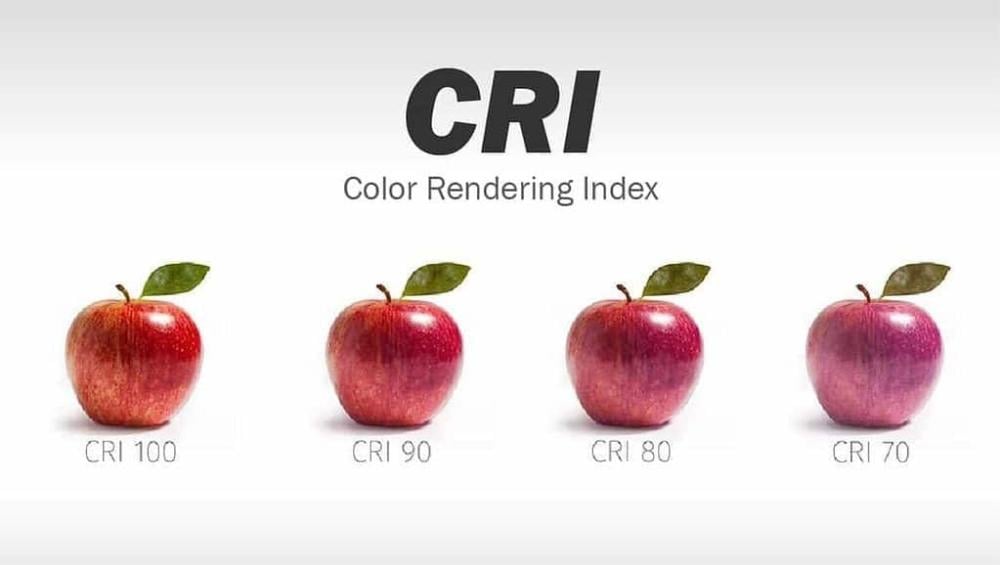
The Color Rendering Index (CRI) is a key indicator of lighting clarity and the accurate representation of colors for everything around you—furniture, décor, and more.
Let’s dive deeper into what it means and why it’s essential for choosing the right lighting for your space.
What is CRI (Color Rendering Index)?
CRI is a measure of how accurately a light source reveals the true colors of the objects it illuminates, allowing you to see colors as close to natural daylight as possible.
Also referred to as color clarity or color rendering accuracy, CRI values range from 0 to 100. The closer the value is to 100, the more natural and accurate the colors will appear, similar to how they would look under sunlight.
You’ll typically find this number labeled on lighting product packaging, especially for modern fixtures like chandeliers, wall sconces, or spotlights.
We’ll explore real-life examples shortly to help you choose the best CRI rating for various indoor and outdoor areas.
How CRI Helps Determine Suitable Lighting for Your Home
High CRI lighting enhances the vibrancy of furniture, wall paint, and décor. It helps you see colors as they truly are, as if viewed in natural daylight.
To choose the right home lighting, we recommend using high-CRI wall lights near mirrors, in dressing rooms, guest areas, and study rooms.
That said, lights with a CRI below 80 aren't necessarily bad, they can still work well for decorative or ambient purposes, such as above a vase or in a cozy corner.
In bedrooms or hallways where soft, relaxing light is desired, lower CRI lighting can create a calm atmosphere.
For garages, gardens, or outdoor paths, low CRI lighting is generally sufficient since the main goal is visibility at night, helping reduce costs without compromising function.
CRI in Workspaces and Commercial Settings
In retail stores, high CRI lighting is essential. It helps showcase the true colors of products and makes it easier for customers to distinguish between similar shades—like black and navy blue.
Poor lighting can blur color differences, but high-CRI bulbs and spotlights solve this problem, improving the shopping experience.
High CRI lighting is also crucial in clinics, hospitals, and offices, where precision and professionalism are required for visual tasks.
It’s important to note that CRI is different from brightness, which is measured in lumens.
Both CRI and lumens work together to improve overall lighting quality.
The Relationship Between CRI and Lighting Distribution
Even with high CRI lights, if lighting is poorly distributed in a room, you’ll end up with dark spots that reduce visibility and color accuracy.
That’s why both CRI and lighting layout must be considered to achieve optimal results.
When interior designers plan lighting for a space, they often vary the CRI levels of different fixtures.
For example, a room might combine spotlights with CRI > 80 in corners and edges, supported by central lighting with CRI > 90 for a balanced, immersive lighting effect.
It’s also not cost-effective to use only high-CRI lighting throughout. A smart mix of high and medium CRI fixtures, depending on purpose, can significantly cut costs while maintaining visual appeal.
Say goodbye to dull décor and inaccurate colors by selecting lighting with the right CRI.
That’s why we’re here, to clarify everything you need to know about lighting concepts and help you choose the best solutions.
Explore more lighting tips and insights on the Fanos Blog.